

Built starting in 1630, the Madeleine Cloister is the last remaining vestige of the Capuchin monastery in Albi, located in the suburb at the “end of the bridge,” now the Madeleine district. Two recent meetings allowed us to take stock of existing sources that could help write a history of the Capuchins of Albi, or to examine the current building to find traces of the past.
The first meeting, on December 4, 2025, took us to the diocesan archives, where we were received by Cédric Trouche-Marty, diocesan archivist, historian, and archaeologist, and his colleague Françoise Bardy. Our conversation with Mr. Trouche-Marty revealed that there did not appear to be any formal archives of the Capuchins of Albi. Dedicated records exist for the Capuchin friars of Gaillac or Cordes in local archives, but nothing for Albi. This does not mean, however, that it is impossible to write their history.
There are indirect ways to retrieve information. Through printed materials and inventories of municipal or departmental archives, it is possible to discover references. Cédric Trouche was able to conduct some research and compile a non-exhaustive list of these indirect sources, which you can consult by clicking here. We find it particularly intriguing that there appear to be no images in any public records showing how the former Madeleine Church (before 1850s) looked with its placement directly on the Rue de la Madeleine.
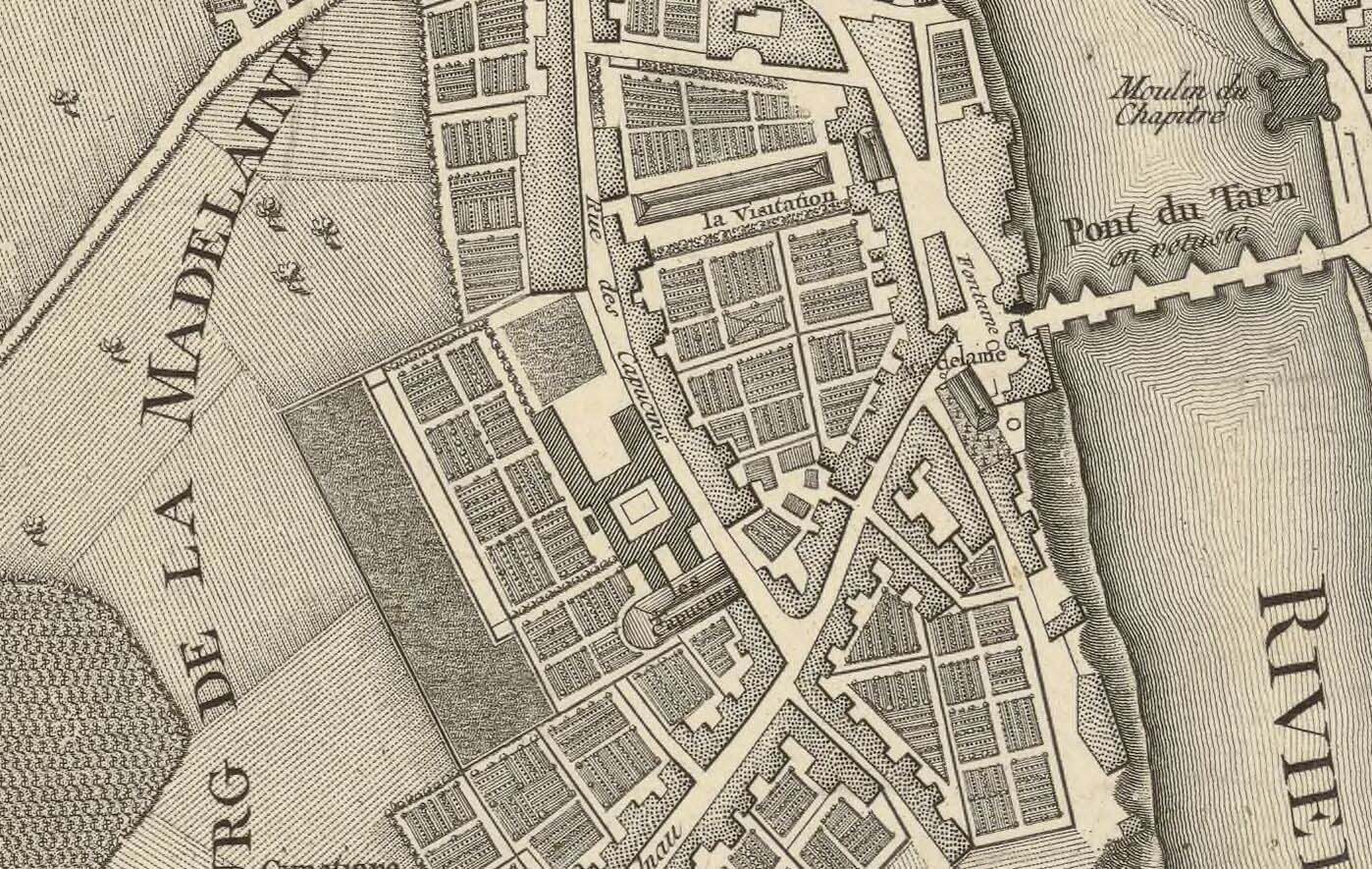
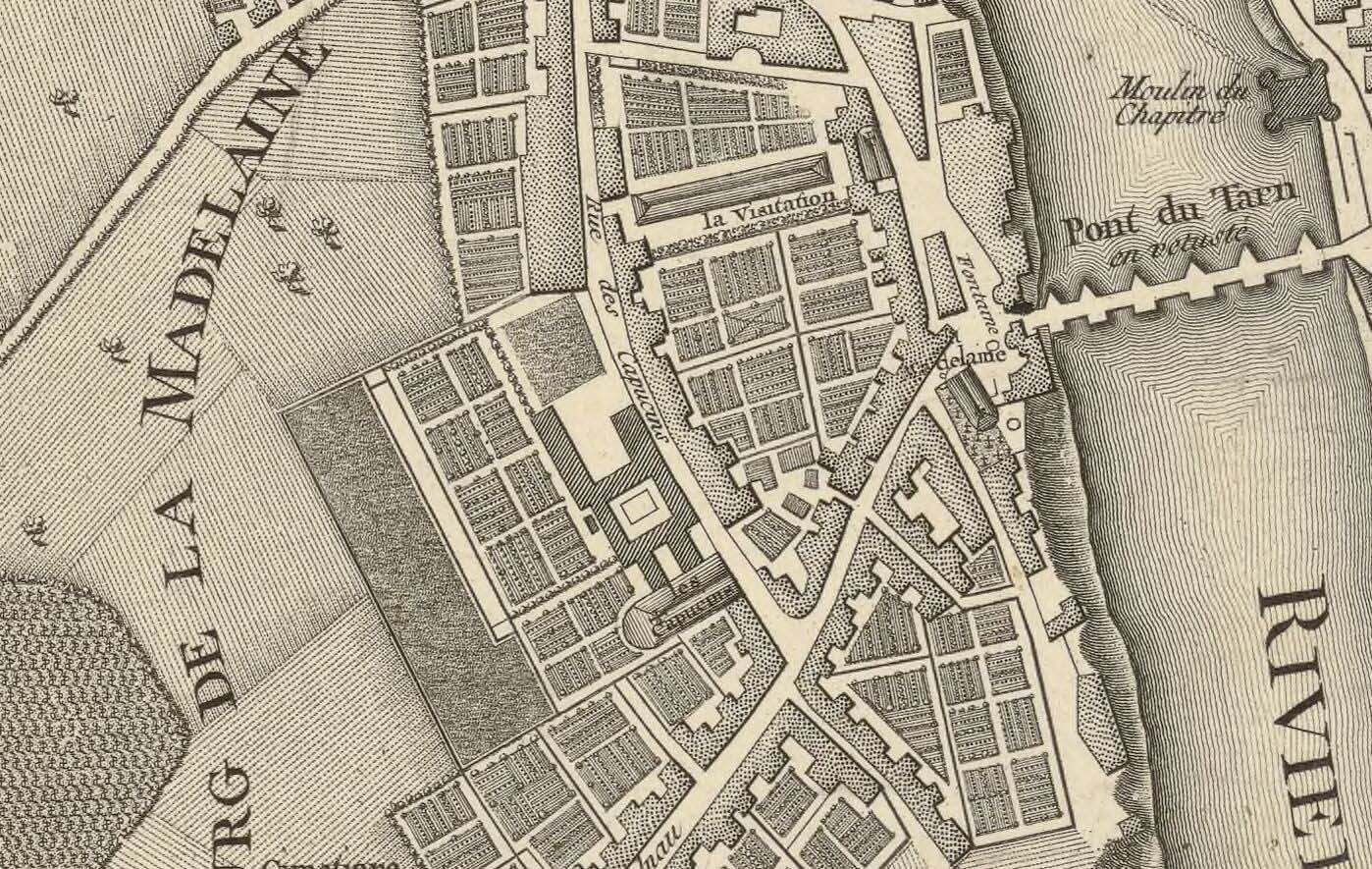
Extract from Plan de la ville et des faubourgs d’Alby / La Roche fecit, 18th century – Source: National Library of France, Maps and Plans Department, GE C-2737.
The second on-site meeting took place on February 17th. Cédric Trouche and Françoise Bardy came accompanied by Sonia Servant, a research officer at the Heritage Inventory for the Tarn Council of Architecture, Urban Planning and the Environment; Jean Le Pottier, former curator of the Tarn Departmental Archives; and his wife, Nicole Le Pottier, a university professor and archivist-paleographer, both well-known in the world of historical research.
Discussions flowed freely throughout the visit to the site, now occupied by the new American owners. In the end, many questions were asked, but very few answers were provided. And for good reason, as Sonia Servant so aptly pointed out, the cloister has undergone far too many successive renovations (those by Hervé Canivet in the 1990s, then by the Cardete and Huet firm in the 2000s; and finally, the recent work by SAFRA Agencement), making it difficult to imagine how the spaces were originally occupied, given how much the volumes have been redefined. One has to go down into the cellars to find fingerprints on the masonry, echoes of the builders of the place, as Cédric Trouche, an archaeologist by training, marveled.
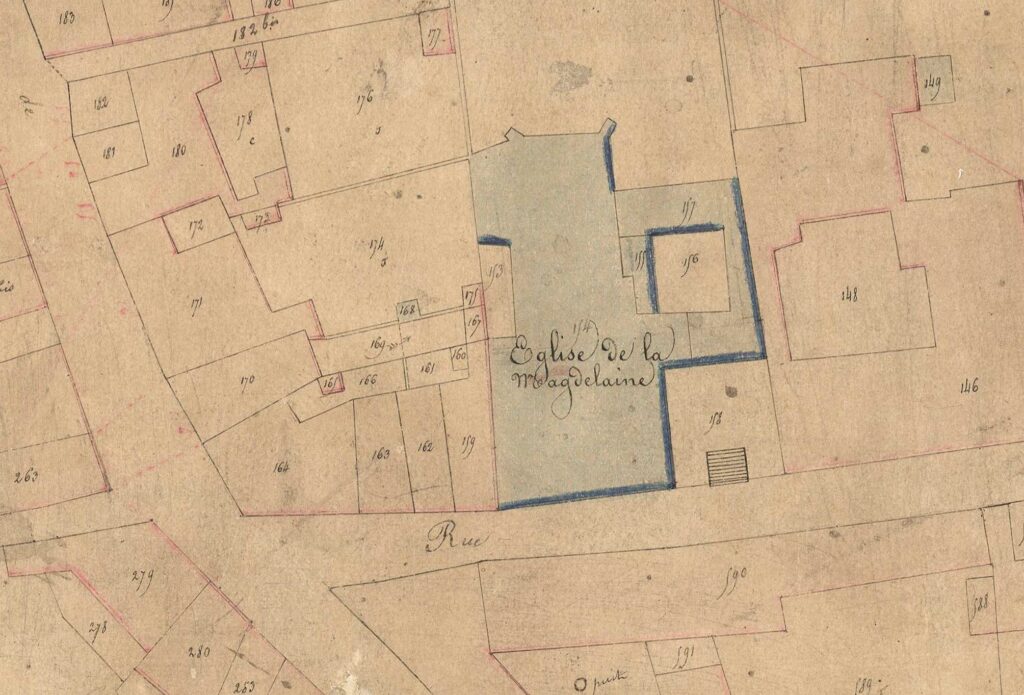
Extract from the Napoleonic land register, 1810. Source: Tarn Departmental Archives.
Jean Le Pottier mentioned the possibility of finding information in Toulouse. He then wondered if any archives of the Maraval family existed concerning the hat-making industry in the 19th and 20th centuries.
One point in particular concerned the group during their visit. It relates to the two wings of the building that now comprise 42 rue de la Madeleine. While they appear on the 18th-century La Roche map, they are absent from the later Napoleonic land registry. Similarly, the rear wing seems to be slightly offset from the cloister on the first map, an offset that does not correspond to the current building.
Over the course of these two meetings, we were able to appreciate how difficult it would be to embark on tracing the history of the Capuchins of Albi, especially since fluency in Latin and Occitan would be essential, as Nicole La Pottier emphasized. Everyone involved expressed their desire to share the results of their past and future research with us. We will certainly incorporate these findings into future articles or on the page dedicated to the history of the site. In the same time, we’d love to hear from anyone with historical or anecdotal knowledge, particularly photographs and drawings, of any material related to our particular building. If it’s the case, you can use the contact form on this page.